
Artificial intelligence has transformed content creation. Today, students use AI to summarize study materials, bloggers draft articles in minutes, marketers generate advertising copy, and businesses create emails, product descriptions, and social media posts faster than ever before. AI writing assistants have made producing content more efficient, but they have also introduced a new challenge: making that content sound genuinely human.
If you’ve ever read AI-generated text that felt repetitive, overly formal, or lacking personality, you’re not alone. While modern AI models can generate grammatically correct sentences, they often struggle to capture the natural rhythm, tone, and subtle variations that make human writing engaging. Readers may not always know why a passage feels unnatural, but they can usually sense when it lacks authenticity.
This is where AI humanizers come in.
Rather than creating new ideas, an AI humanizer refines existing text. It improves sentence flow, reduces repetitive phrasing, adjusts tone, and enhances readability while preserving the original meaning. The goal isn’t to disguise content—it is to make communication clearer, smoother, and more enjoyable for real people. Whether you’re a student polishing an assignment, a blogger improving an article, a freelancer preparing client work, or a business owner creating website content, understanding how AI humanizers work can help you use them more effectively and avoid common mistakes.
In this comprehensive guide, you’ll learn:
- What an AI humanizer is
- Why AI-generated content sometimes sounds artificial
- How AI humanizers work behind the scenes
- The technologies that power these tools
- Their benefits and limitations
- Best practices for achieving natural results
- When human editing is still essential
By the end of this article, you’ll have a clear understanding of what AI humanizers can—and cannot—do, allowing you to use them more effectively in your writing workflow.
This is excellent for:
- Featured Snippets,
- Google AI Overviews,
- Readers who skim articles,
- Better user experience.
AI humanizers work by analyzing AI-generated text, identifying repetitive or unnatural writing patterns, and rewriting the content to improve readability, sentence flow, and tone while preserving the original meaning. They use Natural Language Processing (NLP) and large language models (LLMs) to produce more natural, engaging writing.
Key Takeaways
If you’re short on time, here’s what you need to know about AI humanizers:
- AI humanizers improve AI-generated or manually written text by making it sound more natural and engaging.
- They enhance sentence flow, readability, vocabulary, and tone without changing the original meaning.
- Most AI humanizers use Natural Language Processing (NLP) and Large Language Models (LLMs) to analyze and refine text.
- They work best as editing assistants, not as replacements for human creativity or expertise.
- AI humanizers cannot guarantee that content will bypass AI detectors, as detection methods vary and evolve.
- The best results come from combining AI-assisted editing with careful human review, fact-checking, and original insights.
💡 Quick Tip: Think of an AI humanizer as a professional editor—it polishes your writing but doesn’t replace your knowledge, ideas, or unique voice.
What Is an AI Humanizer and How Does It Work?
An AI humanizer is a writing refinement tool that improves AI-generated text so it reads more naturally while preserving the original message. Instead of rewriting content from scratch, it focuses on improving how ideas are expressed.
Think of it as an editor rather than an author.
A quality AI humanizer analyzes your writing for patterns that commonly appear in machine-generated content. These patterns may include repetitive sentence structures, awkward transitions, overly formal language, or paragraphs that all follow the same rhythm. It then suggests or applies changes that make the writing feel smoother and more conversational.
For example, consider this AI-generated paragraph:
Original Version
Artificial intelligence is an effective technology. It helps people create content efficiently. It saves time and improves productivity.
While the information is correct, the writing feels mechanical because each sentence follows a similar structure. A refined version could read:
Humanized Version
Artificial intelligence has become an essential part of modern content creation, helping people work more efficiently while saving valuable time and improving productivity.
Both versions communicate the same idea, but the second flows more naturally and is easier to read. A well-designed AI humanizer does not invent new facts or change your intended meaning. Instead, it improves:
- Sentence flow,
- Vocabulary variety,
- Paragraph rhythm,
- Readability,
- Tone consistency,
- Overall writing quality.
This makes it a valuable editing assistant rather than a replacement for human creativity.
AI-Generated Text vs Humanized Text
| Feature | AI-Generated Text | Humanized Text |
|---|---|---|
| Writing Style | Often formal, predictable, and repetitive | Natural, conversational, and engaging |
| Sentence Structure | Similar sentence lengths and patterns | Mix of short and long sentences for better flow |
| Vocabulary | Common words and repeated phrases | More varied vocabulary with natural word choices |
| Readability | Can feel robotic or difficult to stay engaged with | Smooth, easy to read, and enjoyable |
| Tone | May sound generic or impersonal | Better reflects the intended audience and purpose |
| Transitions | Uses repetitive connectors like “Furthermore” or “Moreover” | Uses natural transitions that improve flow |
| Original Expression | Often follows common AI writing patterns | Feels more authentic and less formulaic |
| Emotional Connection | Limited personality and emotion | More relatable, expressive, and reader-friendly |
| Best Use Case | Creating a fast first draft | Refining content before publishing |
| Human Editing Needed? | Yes, recommended | Yes, for final fact-checking and personal insights |
Example
| AI-Generated Version | Humanized Version |
|---|---|
| Artificial intelligence is an effective technology. It helps people create content efficiently. It saves time and improves productivity. | Artificial intelligence helps people create content faster by reducing repetitive writing tasks, allowing them to spend more time on creativity, planning, and meaningful work. |
Key takeaway: AI-generated content provides a solid starting point, while humanized content focuses on improving readability, flow, and engagement. The best results usually come from combining AI assistance with careful human review.
Why AI-Generated Content Sometimes Sounds Artificial
To understand how AI humanizers work, it’s important to first understand why AI-generated text often feels different from human writing.
Large language models generate text by predicting the most likely next word based on patterns learned from vast amounts of training data. This approach is remarkably effective, but it can also produce recognizable writing habits that experienced readers quickly notice.
Some of the most common characteristics include:
1. Repetitive Sentence Patterns
AI frequently starts consecutive sentences in similar ways, making paragraphs feel predictable.
For example:
- “Additionally…”
- “Furthermore…”
- “Moreover…”
When these transitions appear repeatedly, the writing becomes monotonous.
2. Uniform Paragraph Length
Human writers naturally vary paragraph length depending on the topic and emphasis. AI-generated content often produces paragraphs of almost identical size, giving the article a mechanical rhythm.
3. Overly Safe Vocabulary
AI tends to choose common words that are broadly applicable. While this makes the writing grammatically correct, it can also make it sound generic and less engaging.
4. Formal or Robotic Tone
Many AI-generated articles sound as though they were written for a report instead of a conversation. Readers generally respond better to writing that feels approachable and natural.
5. Limited Personality
One of the biggest differences between human writing and AI-generated text is personality. Experienced writers naturally include:
- subtle humor,
- personal observations,
- emphasis,
- conversational phrasing,
- emotional nuance.
AI usually avoids these elements unless specifically instructed.
How AI Humanizers Work Behind the Scenes
Although different AI humanizers use different technologies, most follow a similar workflow. Understanding this process helps explain why these tools improve readability without completely changing your writing.
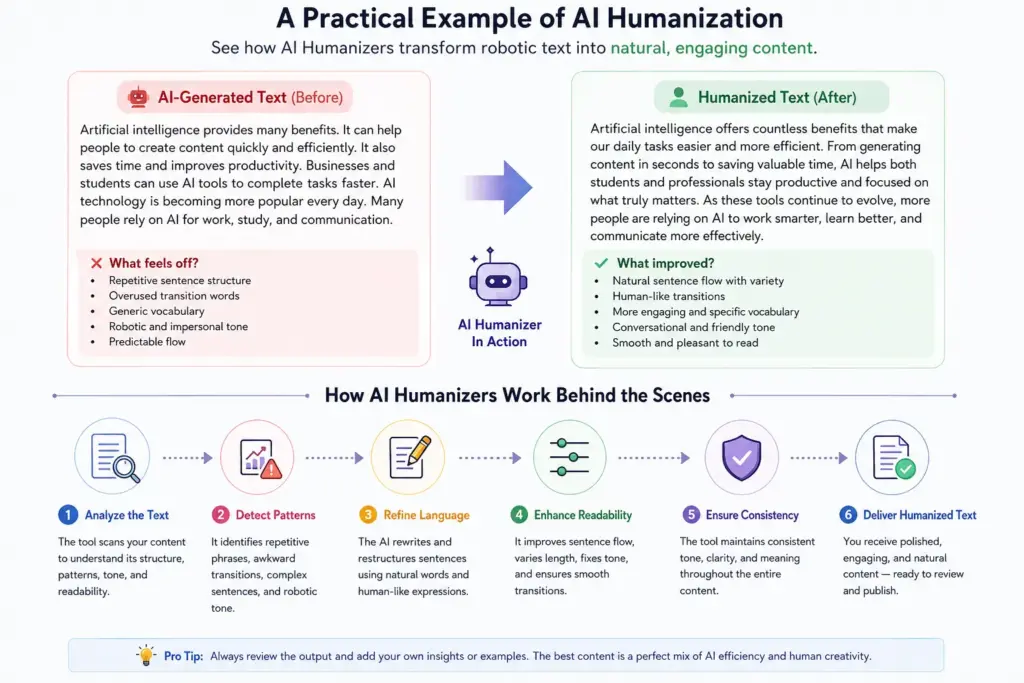
Step 1: Understanding the Content
The first stage is analysis.
Before making any edits, the software studies the text to understand how it is written rather than immediately replacing words.
It typically examines:
- Sentence length,
- Paragraph structure,
- Word repetition,
- Vocabulary diversity,
- Grammar,
- Readability,
- Overall tone,
- Writing consistency.
Instead of asking, “Which words should I replace?” the system asks a more useful question:
“What makes this passage feel less natural to a human reader?”
This broader analysis allows the tool to make smarter improvements instead of random substitutions.
Step 2: Identifying Writing Patterns
Once the content has been analyzed, the AI looks for writing habits commonly associated with machine-generated text.
Examples include:
- Repeated sentence openings,
- Excessive transition words,
- Nearly identical sentence lengths,
- Awkward phrasing,
- Overuse of passive voice,
- Predictable vocabulary,
- Redundant expressions.
The purpose isn’t to label content as “AI-written.” Instead, it’s to identify opportunities to improve readability and make the writing feel more natural.
Step 3: Refining Language Without Changing the Meaning
After identifying areas that can be improved, the AI humanizer begins refining the text. Contrary to what many people believe, a quality AI humanizer doesn’t simply replace difficult words with simpler ones. Instead, it evaluates the relationship between sentences, paragraphs, and the overall message before making adjustments.
At this stage, the tool may:
- Rewrite repetitive sentences using different structures.
- Replace awkward transitions with smoother alternatives.
- Simplify unnecessarily complex wording.
- Improve sentence variety.
- Remove redundant phrases.
- Create better connections between ideas.
The goal is to make the writing easier to read while preserving the author’s intent.
For example, instead of changing every word, the tool might combine two short sentences into one more natural sentence or split a long paragraph into smaller sections that are easier to scan. This process improves readability without altering the core information.
Step 4: Improving Readability
Readability is one of the biggest reasons people use AI humanizers. Even perfectly grammatical content can be difficult to read if every sentence follows the same rhythm.
A good AI humanizer improves readability by:
- Varying sentence length.
- Breaking up long paragraphs.
- Using more natural transitions.
- Removing unnecessary repetition.
- Choosing words that fit the intended audience.
- Making complex explanations easier to understand.
Instead of sounding like a technical report, the content begins to feel more like a conversation with an experienced writer.
This is especially valuable for:
- Educational articles,
- Blog posts,
- Product descriptions,
- Website copy,
- Marketing content,
- Emails,
- Documentation.
The easier your writing is to understand, the longer readers are likely to stay engaged.
Step 5: Checking Tone and Consistency
One paragraph shouldn’t sound formal while the next sounds casual. Modern AI humanizers analyze tone throughout the document to keep the writing consistent. Depending on the intended audience, the software may help maintain a tone that is:
- Professional,
- Friendly,
- Educational,
- Conversational,
- Informative,
- Persuasive.
For example, an academic article requires a different writing style than a travel blog or a product review. Maintaining a consistent voice makes content feel more polished and trustworthy.
Technologies That Power AI Humanizers
Although different platforms use different methods, most modern AI humanizers rely on several core technologies working together.
Natural Language Processing (NLP)
Natural Language Processing helps computers understand how humans communicate. Instead of viewing text as isolated words, NLP analyzes:
- Grammar,
- Context,
- Sentence relationships,
- Meaning,
- Intent.
This allows the software to make improvements that feel natural rather than random.
Large Language Models (LLMs)
Many AI humanizers are built using advanced language models that have been trained on enormous collections of books, articles, conversations, and websites. These models have learned patterns found in high-quality writing, allowing them to:
- restructure sentences,
- improve flow,
- enhance clarity,
- suggest more natural phrasing.
However, they should be viewed as writing assistants—not replacements for careful editing.
Context Analysis
Changing a single word without understanding context can completely change a sentence. Quality AI humanizers analyze surrounding sentences before making changes. For example, the word “draft” has different meanings depending on whether you’re writing about sports, architecture, writing, or engineering. Understanding context helps prevent awkward rewrites.
Readability Analysis
Many AI humanizers also evaluate readability using established writing principles. Rather than focusing only on grammar, they examine factors such as:
- average sentence length,
- paragraph structure,
- transition usage,
- word repetition,
- overall reading difficulty.
The result is writing that is easier for a wider audience to understand.
A Practical Example of AI Humanization
Let’s look at a simple example.
Original AI-Generated Text
Artificial intelligence provides many benefits. It improves productivity. It helps people create content quickly. It also saves time. Businesses can use AI to improve efficiency.
The information is correct, but the writing feels repetitive and mechanical.
Improved Version
Artificial intelligence helps people create content more efficiently by reducing the time spent on repetitive writing tasks. Businesses, students, and creators can use AI to improve productivity while focusing more on creativity, planning, and decision-making.
Notice what changed:
- Better sentence flow.
- Less repetition.
- More natural vocabulary.
- Improved rhythm.
- Same overall meaning.
The objective isn’t to hide the fact that AI assisted with writing. The objective is to improve the reading experience.
Benefits of AI Humanizers for Writers, Students, and Businesses
When used responsibly, AI humanizers can become valuable editing assistants.
1. Better Readability
Clear writing keeps readers engaged. Small improvements in sentence flow often make a significant difference in how easily people understand your content.
2. Faster Editing
Instead of rewriting every paragraph manually, writers can use AI humanizers to produce a stronger first draft before making final edits themselves. This can save considerable time without sacrificing quality.
3. More Natural Writing Style
By reducing repetitive phrasing and introducing greater sentence variety, AI humanizers help content sound less mechanical and more conversational.
4. Consistent Tone
Maintaining the same voice throughout a long article is challenging. AI humanizers can help keep the tone consistent from introduction to conclusion.
5. Improved User Experience
Readers are more likely to stay on a page when the content is enjoyable to read. Better readability can contribute to:
- longer engagement,
- improved comprehension,
- reduced frustration,
- a smoother reading experience.
How We Recommend Using AI Humanizers
At ToolMindAI, we recommend treating an AI humanizer as an editing assistant rather than a replacement for your own judgment. A practical workflow might look like this:
- Write or generate your initial draft.
- Review the content for accuracy.
- Use an AI humanizer to improve readability and sentence flow.
- Edit the output manually to ensure it reflects your intended voice and audience.
- Perform a final proofread before publishing.
This combination of AI assistance and human review generally produces better results than relying on either approach alone.
Our Observation
Based on our evaluation of AI-assisted writing workflows, AI humanizers are most effective when they are used to improve clarity rather than completely rewrite content. They can significantly enhance readability and reduce repetitive phrasing, but they should not replace careful fact-checking, original research, or personal expertise.
Readers value authentic insights, and no editing tool can substitute for genuine experience.
Limitations of AI Humanizers
Although AI humanizers can significantly improve the readability of AI-generated content, they are not perfect. Understanding their limitations helps you set realistic expectations and produce higher-quality work.
1. They Can’t Verify Facts
An AI humanizer focuses on how something is written, not whether it is true. If your original content contains incorrect information, outdated statistics, or unsupported claims, the humanizer may rewrite those statements more smoothly—but it won’t necessarily correct them. Always fact-check important information before publishing.
2. They Don’t Replace Personal Experience
Readers appreciate articles that include genuine insights, practical examples, or lessons learned from real-world use. While AI can improve wording, it cannot replace authentic expertise or firsthand experience. Adding your own observations, examples, or case studies makes content more valuable and trustworthy.
3. Context Still Matters
Some technical, legal, financial, or medical content requires careful wording. Even if an AI humanizer improves readability, you should manually review specialized content to ensure accuracy and appropriate tone.
4. Human Review Is Still Essential
Publishing content without reading it yourself is never a good idea. A final review helps you:
- Check facts,
- Verify links,
- Correct formatting,
- Ensure consistency,
- Remove unnecessary repetition,
- Confirm the article matches your audience.
The best results usually come from combining AI assistance with human judgment.
Can AI Humanizers Bypass AI Detectors?
This is one of the most common questions people ask.
The short answer is:
No AI humanizer can reliably guarantee that content will avoid detection by every AI detector.
AI detection systems use different methods, and they are constantly evolving. Likewise, AI humanizers are continually improving. Because both technologies change over time, there is no permanent or guaranteed outcome. Instead of focusing on “beating” AI detectors, it’s more productive to focus on creating content that is:
- Accurate,
- Helpful,
- Well-structured,
- Easy to read,
- Original,
- Valuable to your audience.
Search engines such as Google prioritize high-quality, people-first content rather than whether AI tools were involved in the writing process. Using AI responsibly as part of your workflow is generally more important than trying to manipulate detection systems.
Google also recommends creating content primarily to help people rather than to manipulate search rankings. Their guidance emphasizes originality, expertise, and usefulness over the method used to create the content.
Best Practices for Using AI Humanizers
To get the most value from an AI humanizer, consider these practical recommendations.
Start with a Strong Draft
AI humanizers work best when the original content already has a clear structure and accurate information. Think of the tool as polishing your writing rather than creating it from scratch.
Keep Your Own Voice
Your writing style is part of your identity. After using an AI humanizer, review the content and make adjustments so it reflects your own tone, audience, and purpose.
Add Original Insights
Readers appreciate information they can’t find everywhere else. Consider including:
- Personal observations,
- Practical examples,
- Lessons learned,
- Industry-specific tips,
- Frequently overlooked details.
These additions make your content more unique and useful.
Verify Important Information
Always review:
- Statistics,
- Dates,
- Names,
- Technical details,
- External references.
Accuracy builds credibility.
Focus on Helping Readers
The ultimate goal isn’t to make text “look human.” It’s to make it more helpful. If every edit improves clarity, usefulness, and reader understanding, you’re using AI humanizers effectively.
The Future of AI Humanizers
AI writing technology continues to evolve rapidly. Future AI humanizers are likely to become better at understanding:
- Context,
- Audience expectations,
- Writing style,
- Brand voice,
- Multilingual communication,
- Long-form content consistency.
We may also see closer integration with grammar checkers, content editors, and productivity tools, allowing writers to refine their work within a single workflow. However, one thing is unlikely to change: human creativity, critical thinking, and subject expertise will remain essential for producing content that genuinely connects with readers.
Key Takeaways
Here’s what we’ve learned:
- AI humanizers improve existing text rather than creating entirely new ideas.
- They refine sentence flow, readability, and tone while preserving the original meaning.
- Most tools rely on Natural Language Processing, language models, and context analysis.
- They work best as editing assistants—not replacements for human writers.
- Fact-checking, personal expertise, and manual review remain essential.
- The most effective workflow combines AI efficiency with thoughtful human editing.
When used responsibly, AI humanizers can save time, improve readability, and help produce clearer, more engaging content for a wide range of audiences.
Related AI Tools
- AI Humanizer – Transform robotic or AI-generated text into smoother, more natural writing while preserving the original meaning.
- AI Content Detector – Analyze text for common AI writing patterns and gain insights into readability and writing style.
- AI Prompt Generator – Create well-structured prompts for ChatGPT and other AI assistants to generate better results.
- AI Readability Score Checker – Check readibility score and maintain clarity and originality.
- AI Writing Tips for Students – Discover responsible ways to use AI for studying, assignments, and research while improving your writing skills.
Frequently Asked Questions
What is an AI humanizer?
An AI humanizer is a tool that improves AI-generated or manually written text by making it read more naturally. It focuses on sentence flow, readability, tone, and overall writing quality while preserving the original meaning.
How do AI humanizers work?
They analyze writing patterns, identify repetitive or unnatural phrasing, and rewrite sentences to improve clarity, variety, and readability using technologies such as Natural Language Processing (NLP) and large language models (LLMs).
Can AI humanizers improve human-written content?
Yes. They can also refine content written by humans by improving flow, fixing awkward phrasing, reducing repetition, and enhancing consistency.
Are AI humanizers suitable for students?
They can be useful for improving readability and grammar, but students should always ensure that submitted work follows their institution’s academic integrity policies and accurately reflects their own understanding.
Can businesses use AI humanizers?
Yes. Businesses often use them to refine marketing copy, blog posts, emails, website content, and product descriptions while maintaining a consistent brand voice.
Do AI humanizers change the meaning of my writing?
High-quality tools aim to preserve the original meaning while improving expression. However, it’s still important to review the output to ensure nothing important has changed.
Are AI humanizers free?
Some platforms offer free versions with basic features, while others provide premium plans with advanced capabilities, higher usage limits, or additional writing tools.
Should I edit the output after using an AI humanizer?
Yes. A final manual review helps ensure the content is accurate, consistent, and aligned with your intended audience and purpose.
Final Thoughts on How AI Humanizers Work
AI humanizers have become valuable tools for anyone who wants to create clearer, more engaging content. By improving readability, reducing repetitive phrasing, and refining tone, they can help transform a rough draft into a polished piece of writing. However, the best content is rarely produced by AI alone. Combining AI-assisted editing with human expertise, careful fact-checking, and original insights creates content that is both informative and genuinely useful.
This approach also aligns with Google’s guidance on creating helpful, reliable, people-first content, which encourages creators to focus on delivering genuine value and demonstrating experience and expertise rather than producing content solely for search engines.
Whether you’re a student, creator, marketer, or business owner, understanding how AI humanizers work allows you to use them more effectively—and ultimately produce content that serves your readers better.
Continue Learning with ToolMindAI
If you found this guide helpful, you may also enjoy these related resources on ToolMindAI:
- AI Content Detector
- AI Prompt Generator
- AI Writing Tips for Students
- Best AI Tools for Content Creators
Explore our growing collection of AI tools and educational guides designed to help students, professionals, and creators work more efficiently while producing high-quality content.
Great content! Keep up the good work!
Thank you for your kind words! I’m glad you found the article helpful. I’ll continue publishing more useful tutorials and free tools. If there’s any topic or tool you’d like to see next, feel free to let me know. Have a great day! 😊