
Calculating percentages is an essential math skill for students. Whether you are checking exam marks, comparing academic results, calculating a discount, measuring an increase, or understanding statistics, percentages help you describe a value in relation to a whole.
For students, one of the most common questions is how to calculate percentage from marks. The calculation is straightforward once you identify the part and the whole. Other situations require slightly different methods, such as finding a percentage of a number or calculating how much a value has increased or decreased.
This guide explains the most useful percentage formulas with original examples and step-by-step calculations. You will learn how to calculate percentage from marks, find a percentage of a number, calculate percentage increase and decrease, understand percentage points, and avoid common mistakes.
You can also use a percentage calculator to verify your calculations after learning the underlying method.
Quick Answer: How Do You Calculate Percentage?
The basic percentage formula is:
Percentage = (Part ÷ Whole) × 100
For example, if you score 72 marks out of 90:
(72 ÷ 90) × 100 = 80%
Therefore, your percentage is 80%.
For percentage increase or decrease, compare the amount of change with the original value.
Key Takeaways
- The basic formula is (Part ÷ Whole) × 100.
- To calculate exam percentage, divide marks obtained by total marks and multiply by 100.
- To find a percentage of a number, divide the percentage by 100 and multiply by the number.
- Percentage increase uses the original value as the reference.
- Percentage decrease also uses the original value as the reference.
- A percentage-point difference is not the same as a percentage change.
- Always check whether your answer is reasonable before accepting it.
What Is a Percentage?
A percentage expresses a quantity in relation to 100. The symbol % means percent, which literally refers to a value per hundred.
For additional practice with the relationship between parts, wholes, and percentages, see this Khan Academy lesson on percentages.
For example:
| Percentage | Meaning |
|---|---|
| 10% | 10 out of 100 |
| 25% | 25 out of 100 |
| 50% | Half of the whole |
| 75% | Three-quarters of the whole |
| 100% | The complete amount |
Percentages can also be greater than 100%. For example, 150% represents one and a half times the reference amount. The basic relationship between a part, a whole, and a percentage is also useful when solving academic and everyday problems.
For a technical reference on the use of the % symbol and expressing dimensionless quantities, see the NIST Guide to the SI.
How to Calculate Percentage From Marks
Students frequently use percentages to calculate examination results.
The formula is:
Percentage = (Marks Obtained ÷ Total Marks) × 100
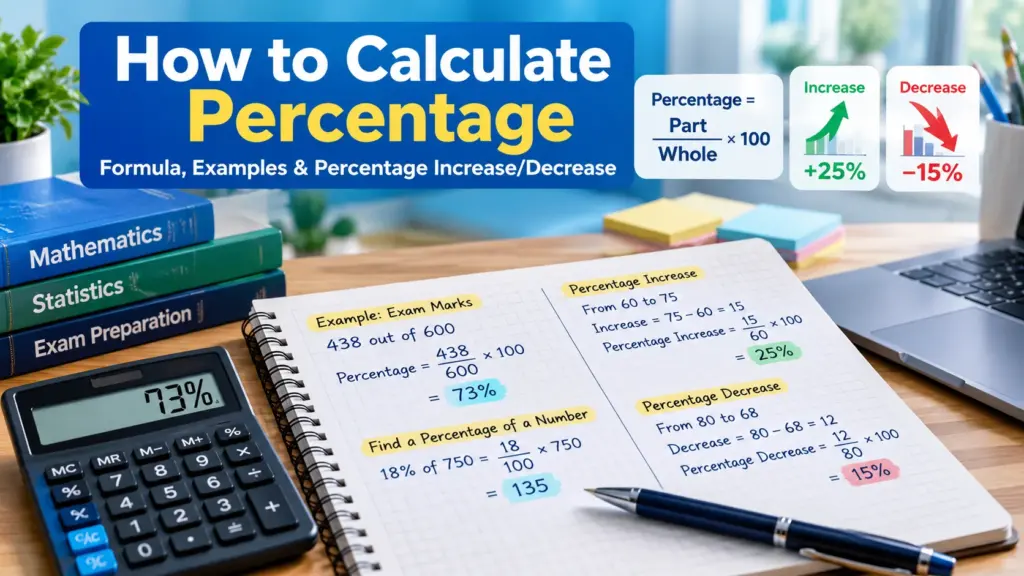
Example 1: Exam Marks
Suppose you scored 438 marks out of 600.
Step 1: Identify the values
- Marks obtained = 438
- Total marks = 600
Step 2: Apply the formula
438 ÷ 600 × 100
Step 3: Calculate
0.73 × 100 = 73%
So, your examination percentage is 73%.
If you want to verify your calculation, you can use the Percentage Calculator on ToolMindAI.
Example 2: Another Student
Suppose a student scores 425 out of 500.
425 ÷ 500 × 100 = 85%
The student’s percentage is therefore 85%.
The same formula can be used whenever you know the marks obtained and the maximum possible marks.
After calculating your percentage, you can also use the Grade Calculator to understand the corresponding grade based on the grading criteria being used.
How to Calculate the Percentage of a Number
Sometimes you already know the percentage but want to find the corresponding amount.
Use:
Percentage Value = (Percentage ÷ 100) × Number
Example
Find 18% of 750.
First convert 18% into decimal form:
18 ÷ 100 = 0.18
Then:
0.18 × 750 = 135
Therefore, 18% of 750 is 135.
This method is useful for calculations involving discounts, attendance, statistics, budgets, and many other situations.
How to Calculate Percentage Increase
A percentage increase tells you how much a value has grown relative to its original value.
Use:
Percentage Increase = [(New Value − Original Value) ÷ Original Value] × 100
Example
Suppose a student’s practice score increases from 60 marks to 75 marks.
First find the increase:
75 − 60 = 15
Then compare the increase with the original score:
15 ÷ 60 × 100 = 25%
Therefore, the score increased by 25%.
The important detail is that 60, the original score, is used as the reference value.
How to Calculate Percentage Decrease
Percentage decrease measures how much a value has fallen relative to its original value.
Use:
Percentage Decrease = [(Original Value − New Value) ÷ Original Value] × 100
Example
Suppose a score changes from 80 to 68.
First calculate the decrease:
80 − 68 = 12
Then:
12 ÷ 80 × 100 = 15%
Therefore, the value decreased by 15%.
The same method can be applied to prices, quantities, test scores, attendance, or other measurable values.
If you want more practice with percent increase and decrease, Khan Academy’s percentage increase and decrease resources provide additional explanations and practice.
Khan Academy’s current educational material similarly uses the original value as the reference when explaining percentage increase and decrease.
Percentage Increase vs. Percentage Points
This is an important distinction when discussing percentages.
Suppose a student’s result changes from 60% to 70%.
The direct difference is:
70% − 60% = 10 percentage points
However, the relative percentage increase is:
10 ÷ 60 × 100 = 16.67%
So the two statements mean different things:
| Measurement | Result |
|---|---|
| Difference in percentage points | 10 points |
| Relative percentage increase | 16.67% |
Use percentage points when describing the direct difference between two percentages. Use percentage increase when measuring the change relative to the original percentage.
Percentage is only one way of representing academic performance. If your institution uses grade points, you can also explore the CGPA Calculator for CGPA-related calculations.
A Simple Method for Solving Percentage Problems
If a percentage question looks confusing, use these three steps.
Step 1: Identify what the numbers represent
Ask yourself:
- What is the part?
- What is the whole?
- Is there an original value?
- Is there a new value?
Step 2: Select the appropriate formula
| Problem | Formula |
|---|---|
| Basic percentage | Part ÷ Whole × 100 |
| Percentage of a number | Percentage ÷ 100 × Number |
| Percentage increase | Increase ÷ Original × 100 |
| Percentage decrease | Decrease ÷ Original × 100 |
Step 3: Check the result
Consider whether the answer makes sense.
For example, if someone scores 45 out of 50, the result should be close to 90%, not 9%.
Common Percentage Calculation Mistakes
1. Reversing the part and whole
For exam marks, the usual calculation is:
Marks obtained ÷ Total marks
Reversing these values can produce an incorrect result.
2. Forgetting to multiply by 100
If 72 ÷ 90 gives 0.8, that is not the final percentage. Multiplying by 100 gives 80%.
3. Using the wrong reference value
Percentage increase and decrease normally use the original value as the reference.
4. Confusing percentage points with percentage change
A movement from 40% to 50% is a 10-percentage-point increase, but the relative increase is 25%.
5. Rounding too early
When a calculation produces decimals, avoid unnecessary rounding before completing the calculation. Round the final answer instead.
How ToolMindAI Can Help With Percentage Calculations
Learning the formula is important, but a calculator can be useful for checking your work.
ToolMindAI provides a Percentage Calculator designed to make common percentage calculations easier. Instead of relying on the calculator blindly, you can first work through the formula manually and then use the tool to verify your answer.
A useful student workflow is:
Understand the formula → Calculate manually → Check the result → Review any difference
This approach helps you learn the underlying math while reducing simple arithmetic errors.
You can also use the Attendance Calculator when you need to calculate attendance percentages or check attendance-related figures.
Note: The calculator’s result depends on the numbers entered by the user. It should be treated as a calculation aid, not a substitute for understanding the formula.
Frequently Asked Questions
What is the basic percentage formula?
The basic formula is (Part ÷ Whole) × 100. For example, if you obtain 45 marks out of 60, calculate 45 ÷ 60 × 100 to get 75%.
How do I calculate percentage from exam marks?
Divide the marks you obtained by the total possible marks and multiply the result by 100. For example, 360 out of 500 gives 360 ÷ 500 × 100 = 72%.
How do I calculate 20% of a number?
Divide 20 by 100 and multiply the result by the number. For example, 20% of 400 is 0.20 × 400 = 80.
Can a percentage be more than 100%?
Yes. A percentage can exceed 100% when the value being measured is greater than the reference amount. For example, 150% means one and a half times the reference amount.
How do I calculate percentage increase?
Subtract the original value from the new value, divide the difference by the original value, and multiply by 100.
How do I calculate percentage decrease?
Subtract the new value from the original value, divide the difference by the original value, and multiply by 100.
What is the difference between percentage and percentage points?
Percentage points show the direct numerical difference between two percentages. Percentage change measures the difference relative to the original value.
Why do I use the original value for percentage change?
The original value provides the reference point for measuring how much something has changed. Using another value as the denominator can produce a different result.
Can I calculate percentage without a calculator?
Yes. Simple percentage problems can be solved using basic arithmetic. Learning the formula is more important than relying entirely on a calculator.
Is 80 out of 100 equal to 80%?
Yes. Eighty out of a possible 100 represents 80%, because the percentage is already expressed relative to 100.
Limitations to Keep in Mind
The mathematics of basic percentages is consistent, but how percentages are used can depend on context.
For example, schools and universities may have different rules for converting marks into grades, CGPA, GPA, or final classifications. A percentage calculation itself does not determine an institution’s grading policy.
Similarly, rounding rules can affect the displayed result. If an institution specifies a particular number of decimal places, follow its published rules rather than assuming that every percentage should be rounded in the same way.
Final Thoughts
Percentage calculations become much easier when you identify what each number represents before starting.
For a basic percentage, remember:
Part ÷ Whole × 100
For percentage increase or decrease, calculate the change first and compare it with the original value.
These methods can help with examination marks, academic comparisons, discounts, statistics, and many everyday calculations. Once you understand the relationship between the part, whole, and reference value, most basic percentage problems become much easier to solve.
Use a calculator to verify your work when needed, but keep the formula in mind so you understand why the answer is correct.
Continue Learning
For additional educational practice, Khan Academy provides independent lessons covering percentages, percent change, and related mathematical concepts.
If you need other academic calculations, explore ToolMindAI’s Student Tools collection for additional resources.