

Attendance is one of the simplest academic calculations, but it can become confusing when students need to know how many classes they have attended, how many they have missed, or whether they have reached a required attendance percentage.
The basic calculation is straightforward: divide the number of classes attended by the total number of classes held and multiply the result by 100. However, questions become more practical when you want to know how many more classes you need to attend, how many classes you can still miss, or how to recover from low attendance.
Attendance requirements also depend on the institution. For example, CBSE currently states that students need a minimum of 75% attendance for eligibility for its Class X and XII board examinations, subject to its applicable rules and provisions. Universities and colleges can have their own attendance policies, so students should always check their institution’s official regulations.
This guide explains the attendance percentage formula, worked examples, required-attendance calculations, common mistakes, and how to use an attendance calculator.
How Do You Calculate Attendance Percentage?
Attendance percentage is calculated by dividing the number of classes attended by the total number of classes held and multiplying the result by 100.
The basic formula is:
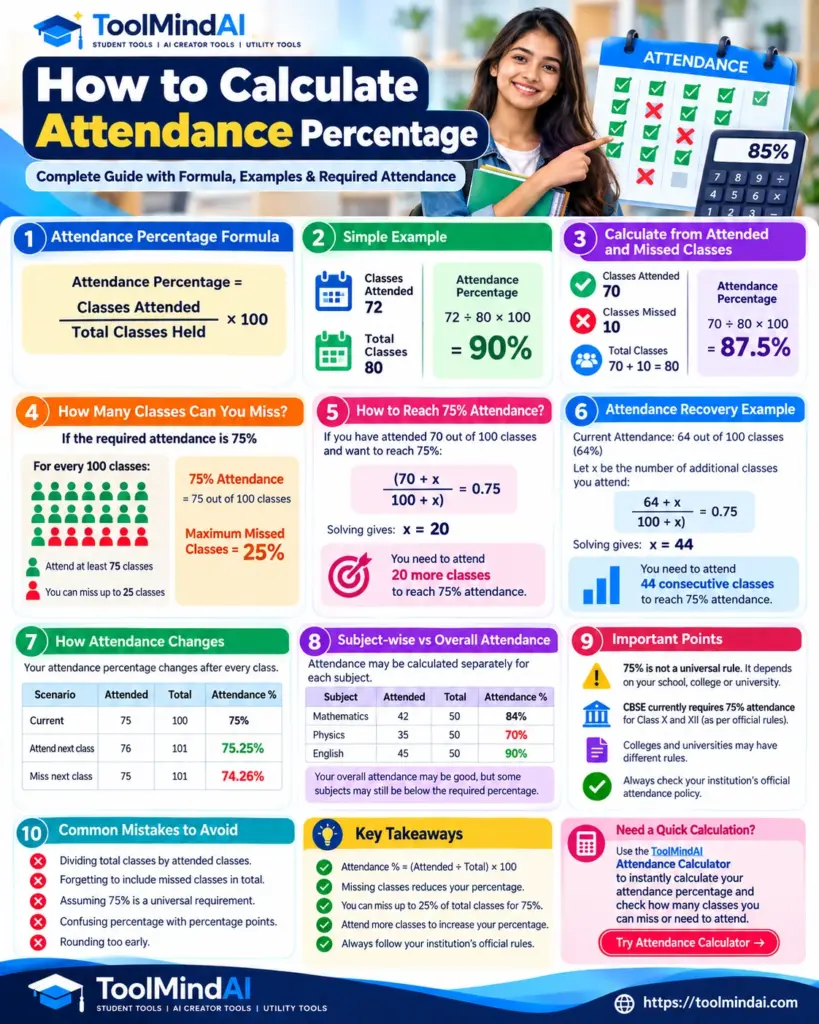
Attendance Percentage = (Classes Attended ÷ Total Classes Held) × 100
For example, if you attended 72 out of 80 classes:
(72 ÷ 80) × 100 = 90%
Your attendance is therefore 90%.
The same formula can be used for school classes, college lectures, practical classes, tutorials, or other attendance-based academic activities, provided your institution counts them in the same way.
Key Takeaways
- Attendance percentage depends on classes attended and total classes held.
- The basic formula is attended classes ÷ total classes × 100.
- Missing classes reduces your attendance percentage because the total number of classes increases while attended classes remain unchanged.
- To calculate how many classes you can miss, you need your current attendance and the required minimum percentage.
- To recover from low attendance, you generally need to attend additional classes without missing more.
- A 75% requirement is common in some Indian educational contexts, but it is not a universal rule for every institution.
- Always check your school’s or university’s official attendance policy before making academic decisions.
What Is Attendance Percentage?
Attendance percentage shows how regularly a student has attended classes compared with the total number of classes conducted.
Suppose your college has conducted 100 classes and you attended 82 of them. Your attendance percentage is:
82 ÷ 100 × 100 = 82%
If you attended 65 classes out of 80:
65 ÷ 80 × 100 = 81.25%
The important point is that total classes held includes both the classes you attended and the classes you missed.
So:
Total Classes = Attended Classes + Missed Classes
This relationship makes it easier to understand most attendance calculations.
Attendance Percentage Formula
The standard formula is:
Attendance Percentage = (Number of Classes Attended ÷ Total Number of Classes Held) × 100
Example 1: Simple attendance calculation
Imagine that 60 classes have been conducted and you attended 51.
Attendance = (51 ÷ 60) × 100
Attendance = 85%
So your attendance is 85%.
Example 2: College attendance
Suppose 120 lectures have been conducted and you attended 96.
Attendance = (96 ÷ 120) × 100
Attendance = 80%
You have therefore attended 80% of the classes.
Example 3: Calculating from attended and missed classes
Suppose you attended 70 classes and missed 10.
First calculate the total:
70 + 10 = 80 classes
Then:
(70 ÷ 80) × 100 = 87.5%
Your attendance is 87.5%.
How to Calculate Attendance from Total Classes
If you know the number of classes attended and the number of classes missed, calculate the total classes first.
Formula
Total Classes = Attended Classes + Missed Classes
Then:
Attendance Percentage = (Attended Classes ÷ Total Classes) × 100
Example
You attended 84 classes and missed 16.
Total classes:
84 + 16 = 100
Attendance:
(84 ÷ 100) × 100 = 84%
Therefore, your attendance is 84%.
This is useful when your college portal gives you separate numbers for present and absent instead of directly showing your attendance percentage.
How to Calculate Required Attendance Percentage
Sometimes you don’t want to know your current attendance. Instead, you want to know whether you can maintain a particular minimum, such as 75%.
For example, suppose you have attended 60 out of 80 classes:
Current attendance = 60 ÷ 80 × 100 = 75%
If you attend the next five classes without missing any:
- Classes attended = 65
- Total classes = 85
Your new attendance becomes:
65 ÷ 85 × 100 = 76.47%
So your attendance increases above 75%.
This demonstrates an important point: attending future classes can gradually improve your percentage, but the improvement becomes slower as the total number of classes increases.
How Many Classes Can You Miss and Still Maintain 75%?
This is one of the most common attendance questions.
If your institution requires 75% attendance, you need:
Attended Classes ÷ Total Classes × 100 ≥ 75
A useful way to understand this is that, over a completed set of classes, you can miss at most 25% of the total classes and still have 75% attendance.
Example
Suppose 100 classes are conducted.
To maintain 75% attendance:
- Required attendance = 75 classes
- Maximum missed classes = 25 classes
Therefore:
75 ÷ 100 × 100 = 75%
However, this does not mean you can automatically miss 25% of every future timetable. Your current attendance matters, and institutions may calculate attendance using specific academic periods, subjects, practicals, tutorials, or semester rules.
For example, CBSE’s current 2025–26 communication reiterates a 75% minimum attendance requirement for eligibility for its Class X and XII board examinations, with specific provisions concerning permitted relaxation and documentation.
So students should never assume that the general 75/25 rule overrides their institution’s own attendance regulations.
For example, CBSE’s official attendance requirements specify a minimum of 75% attendance for students to be eligible for its Class X and XII board examinations, subject to the applicable rules and provisions.
How to Increase Attendance Percentage
If your attendance has fallen below the required level, the most reliable approach is to attend as many upcoming classes as possible.
Suppose you have:
- 70 classes attended
- 100 total classes
- Current attendance = 70%
Now suppose you attend the next 20 classes without missing any.
Your new numbers become:
- Attended = 90
- Total = 120
New attendance:
90 ÷ 120 × 100 = 75%
So attending all 20 additional classes would bring your attendance from 70% to 75%.
This also shows why students should calculate their position early rather than waiting until examinations are approaching.
How Many Classes Do You Need to Attend to Reach 75%?
This can be calculated mathematically.
Suppose you have attended 70 out of 100 classes and want to reach 75%.
Let x be the number of future classes you need to attend.
Your new attendance would be:
(70 + x) ÷ (100 + x) × 100
You want this to reach at least 75%.
Solving the requirement:
(70 + x) ÷ (100 + x) = 0.75
This gives:
70 + x = 75 + 0.75x
0.25x = 5
x = 20
Therefore, you need to attend 20 consecutive classes to reach 75%.
This type of calculation is particularly useful when your current attendance is below the required minimum.
If you want to understand percentage calculations more generally, see our guide on how to calculate percentage.
How to Calculate the Maximum Classes You Can Miss
If you want to maintain a particular minimum attendance percentage, you can work backward from the required percentage.
For a 75% requirement, the general relationship is:
Maximum missed classes = 25% of total classes
For example, if 200 classes are eventually conducted:
- Minimum classes attended = 150
- Maximum classes missed = 50
- Attendance = 150 ÷ 200 × 100 = 75%
However, this is a simplified example. Your actual allowable absences depend on your current attendance and how many classes remain.
Example
Suppose you have attended 90 out of 120 classes.
Your current attendance is:
90 ÷ 120 × 100 = 75%
If you miss the next 10 classes:
- Attended = 90
- Total = 130
New attendance:
90 ÷ 130 × 100 = 69.23%
So being exactly at 75% does not mean you can continue missing classes without affecting your eligibility.
How to Calculate Attendance Recovery
Students often want to know how many consecutive classes they need to attend to bring their attendance back to the required level.
Suppose your current record is:
- Classes attended = 64
- Total classes = 100
- Current attendance = 64%
Let x represent the number of additional classes you attend without missing any.
Your new attendance is:
(64 + x) ÷ (100 + x) × 100
If the target is 75%:
(64 + x) ÷ (100 + x) = 0.75
Solving this gives:
x = 44
Therefore, you would need to attend 44 consecutive classes to reach 75%.
This example also demonstrates why recovering from low attendance can take much longer than students expect.
Subject-Wise Attendance vs Overall Attendance
Another important issue is that institutions may not calculate attendance in exactly the same way.
Some colleges may show:
- Overall semester attendance.
- Subject-wise attendance.
- Practical attendance.
- Tutorial attendance.
- Laboratory attendance.
Your overall attendance may look acceptable while your attendance in an individual subject is lower.
Example
Imagine:
| Subject | Attended | Total | Attendance |
|---|---|---|---|
| Mathematics | 42 | 50 | 84% |
| Physics | 35 | 50 | 70% |
| English | 45 | 50 | 90% |
Your attendance differs significantly between subjects.
Therefore, don’t assume that a good overall percentage automatically means you satisfy every subject-specific requirement.
Always check your institution’s attendance policy and the way your academic portal calculates attendance.
For higher education, attendance requirements can be prescribed by the university or institution. UGC regulations indicate that universities ordinarily prescribe attendance requirements for lectures, tutorials, seminars and practicals, often at not less than 75%, depending on the applicable regulations. See the UGC Regulations for the relevant framework.
Why Attendance Percentage Changes After Every Class
Attendance is not a fixed score. It changes whenever the total number of classes changes.
Suppose you have attended 75 out of 100 classes:
75% attendance
Now you attend the next class:
76 ÷ 101 × 100 = 75.25%
Your attendance increases slightly.
But if you miss the next class instead:
75 ÷ 101 × 100 = 74.26%
Your attendance falls below 75%.
This is why students who are close to the minimum requirement should pay attention to every additional class.
Common Attendance Calculation Mistakes
1. Dividing by attended classes
A common mistake is to calculate:
Total classes ÷ attended classes
The correct calculation is:
Attended classes ÷ total classes × 100
2. Forgetting missed classes
If you attended 70 classes and missed 10, your total isn’t 70.
It is:
70 + 10 = 80
Therefore:
70 ÷ 80 × 100 = 87.5%
3. Assuming 75% is a universal requirement
A 75% requirement applies in some educational contexts, but not every school, college, university, course, or examination system necessarily uses the same requirement.
Students should check their institution’s current regulations.
For example, CBSE’s official 2025 communication specifies a minimum of 75% attendance for eligibility for its Class X and XII board examinations, subject to the applicable rules and permitted provisions.
4. Confusing percentage with percentage points
Suppose your attendance increases from 70% to 75%.
That is an increase of:
5 percentage points
It isn’t accurate to simply describe this as a 5% increase in the mathematical sense.
For attendance records, percentage points are usually the clearer way to describe the difference between two attendance percentages.
5. Rounding too early
Suppose your actual attendance is:
74.6%
Rounding it to 75% could give you the wrong impression if your institution requires a minimum of 75%.
Keep the exact value until the final stage and follow the rounding policy used by your institution.
How ToolMindAI Can Help
Calculating attendance manually is easy when the numbers are small, but it becomes less convenient when you want to compare different scenarios.
The Attendance Calculator can help you quickly determine your attendance percentage from the number of classes attended and the total classes conducted.
For example, instead of repeatedly calculating:
73 ÷ 96 × 100
you can enter the relevant values into the calculator and check the result.
It is particularly useful when you want to:
- Check your current attendance.
- Understand whether you are above a target percentage.
- Compare different attendance scenarios.
- Quickly verify a manual calculation.
The calculator is a convenience tool, however. Your institution’s official attendance record should always be treated as authoritative.
Important Limitations
An online attendance calculator can calculate the mathematics, but it cannot determine your institution’s eligibility rules.
Different institutions may have different:
- Minimum attendance requirements.
- Subject-wise requirements.
- Practical/laboratory requirements.
- Attendance calculation periods.
- Medical or other permitted exemptions.
- Rules for condonation or shortage.
- Rounding policies.
For this reason, use an attendance calculator to check your numbers, not to replace your institution’s official academic regulations.
If your attendance is close to the required minimum, check your student portal, department notice, academic regulations, or examination office for the official position.
For students following CBSE rules, the Board also provides specific procedures for dealing with attendance shortages and requests for condonation. See CBSE’s guidance on shortage of attendance for the applicable process.
Frequently Asked Questions
1. What is the formula for calculating attendance percentage?
The basic formula is:
Attendance Percentage = (Classes Attended ÷ Total Classes Held) × 100
For example, attending 80 out of 100 classes gives an attendance percentage of 80%.
2. How do I calculate attendance if I know attended and missed classes?
First add attended and missed classes to find the total number of classes.
For example:
70 attended + 10 missed = 80 total
Then:
70 ÷ 80 × 100 = 87.5%
3. How many classes can I miss with 75% attendance?
In a simplified example, maintaining 75% attendance means attending at least 75 out of every 100 classes, leaving up to 25 classes absent.
However, your actual allowable absences depend on your current attendance, future classes, and institution-specific rules.
4. How many classes do I need to attend to reach 75%?
It depends on your current attendance.
For example, if you have attended 70 out of 100 classes, you need to attend 20 consecutive additional classes to reach 75%.
The calculation is based on:
(70 + x) ÷ (100 + x) = 0.75
5. Can I increase my attendance percentage by attending every future class?
Yes, mathematically, attending additional classes without missing them will increase your attendance percentage when your current attendance is below 100%.
However, the improvement becomes smaller as the total number of classes increases.
6. Does missing one class reduce attendance by exactly 1%?
No.
The effect depends on the total number of classes already conducted.
Missing one class when only 10 classes have been held has a much larger effect than missing one class after 200 classes have been held.
7. Is 75% attendance compulsory for every college?
No.
Attendance requirements are institution- and programme-specific. Some institutions may use 75%, while others can have different requirements or additional subject-specific rules.
Always check the applicable academic regulations.
8. Is subject-wise attendance different from overall attendance?
It can be.
An institution may calculate attendance separately for individual subjects, practicals, laboratories, or tutorials. Therefore, a student’s overall attendance may not tell the complete story.
9. Does the attendance calculator determine whether I am eligible for an exam?
No.
A calculator can determine the mathematical percentage, but exam eligibility depends on your institution’s rules and official attendance record.
10. How can I check my attendance accurately?
The best source is your institution’s official student portal, attendance register, department, or academic office.
You can then use an attendance calculator to independently verify the mathematical percentage.
Final Thoughts
Attendance percentage is calculated using a simple formula, but understanding what the result means is just as important as performing the calculation.
Start with:
Classes Attended ÷ Total Classes Held × 100
From there, you can determine your current attendance, estimate how many classes you need to attend to reach a target, or understand how missing additional classes could affect your percentage.
If your attendance is close to a required minimum, don’t rely only on a rounded number or a generic 75% rule. Check the attendance policy that applies to your specific school, college, university, programme, and examination.
The Attendance Calculator can help you quickly determine your attendance percentage from the number of classes attended and the total classes conducted.
Continue Learning
If you’re working on other academic calculations, explore these ToolMindAI resources:
- Grade Calculator — Calculate grades from marks and understand your academic result.
- How to Calculate Percentage — Learn how percentages are calculated from marks and numbers.
- How to Calculate CGPA — Understand grade points, credits, SGPA, CGPA, and institutional conversion rules.
- Student Tools — Explore additional academic calculators and educational resources.