

Understanding your grades is an important part of tracking academic progress. Whether you are studying in school, preparing for examinations, or checking your college results, knowing how to calculate grades from marks can help you understand your performance and identify areas for improvement.
The calculation usually starts with your marks. You may first need to calculate your percentage, then compare that percentage with the grading scale used by your school, examination board, college, or university. Some institutions assign letter grades such as A, B, and C, while others use grade points or a combination of marks and grade points.
There is no single grading scale that applies to every educational institution. The percentage required for a particular grade can differ depending on the applicable academic rules. Therefore, a grade chart should always be checked against your institution’s official guidelines.
In this guide, you will learn the basic grade calculation formula, how to calculate percentage from marks, how to use a grade chart, and how to solve common grade calculation problems with step-by-step examples. You will also learn the difference between marks, percentage, grades, and CGPA, and discover how an online grade calculator can simplify the process.
Quick Answer: How Do You Calculate Grades from Marks?
To calculate a grade from marks, first determine the percentage of marks obtained, then compare that percentage with the official grading scale used by your institution.
The basic percentage formula is:
\[ \text{Percentage}=\frac{\text{Marks Obtained}}{\text{Maximum Marks}}\times100 \]
For example, if you score 420 out of 500:
\[ \frac{420}{500}\times100=84\% \]
Your percentage is 84%. Your final grade depends on the grading scale your institution follows.
Key Takeaways
- Calculate your percentage by dividing marks obtained by maximum marks and multiplying by 100.
- Use the official grading scale applicable to your institution to determine your grade.
- Grade boundaries are not universal; the same percentage may receive different grades under different systems.
- If subjects have different maximum marks, calculate the overall percentage using the combined marks rather than averaging subject percentages automatically.
- Grades, grade points, percentage, and CGPA are related but are not interchangeable.
- An online Grade Calculator can help with calculations, but your institution’s official result and grading rules remain authoritative.
1. What Does a Grade Mean?
A grade is a way of describing academic performance. Instead of showing only the exact marks a student received, a grading system groups performance into categories.
Depending on the institution, grades may be represented using:
- Letters: A, B, C, D, or other letter categories.
- Symbols: Such as A+, A, B+, or similar classifications.
- Grade points: Numerical values assigned to particular grades.
- Performance bands: Categories such as excellent, very good, satisfactory, or needs improvement.
For example, two students might receive 82 and 86 marks. Under a particular grading scale, both students could receive the same letter grade even though their marks are different.
This does not mean their exact scores are identical. It means their results fall within the same grade band under that system.
Why do institutions use grading systems?
Grading systems help schools and universities summarize results, evaluate academic progress, and apply consistent assessment rules.
However, institutions can differ in how they set grade boundaries, calculate final results, account for internal assessments, and assign grade points. That is why you should not assume that a grade chart found online automatically applies to your examination.
2. How to Calculate Percentage from Marks
Before converting marks into a grade, you may need to calculate the percentage. For more percentage calculations, try the ToolMindAI Percentage Calculator.
Formula
\[ \text{Percentage}=\frac{\text{Marks Obtained}}{\text{Maximum Marks}}\times100 \]
Here:
- Marks obtained means the marks you actually scored.
- Maximum marks means the highest possible marks for the same assessment or group of assessments.
Example 1: A student scores 72 out of 100
Suppose you score 72 marks in an examination worth 100 marks.
\[ \frac{72}{100}\times100=72\% \]
Your percentage is 72%.
Example 2: A student scores 360 out of 500
Suppose your total score across five subjects is 360 out of a possible 500 marks.
\[ \frac{360}{500}\times100=72\% \]
Your overall percentage is 72%.
Example 3: A student scores 438 out of 600
First identify the marks obtained and maximum marks:
- Marks obtained: 438
- Maximum marks: 600
Now calculate:
\[ \frac{438}{600}\times100=73\% \]
Your overall percentage is 73%.
These examples show how to calculate percentage accurately. To determine the corresponding grade, you must next consult the correct grading scale.
3. How to Calculate a Grade from Marks: Step by Step
Follow these steps whenever you need to calculate a grade from an examination result.
Step 1: Find your marks
Identify your marks obtained and the maximum marks for the assessment.
Step 2: Calculate the percentage
Divide the marks obtained by the maximum marks and multiply by 100.
Step 3: Check the official grade chart
Find the percentage range or marks range specified by your institution.
Step 4: Identify your grade
Match your result to the applicable grade band and check any additional rules.
Worked example
Suppose a student receives 81 marks out of 100.
Step 1: Marks obtained = 81.
Step 2: Maximum marks = 100.
Step 3: Calculate the percentage.
\[ \frac{81}{100}\times100=81\% \]
Step 4: Compare 81% with the institution’s official grading scale.
If the applicable grade chart assigns 80%–89% to grade A, the student’s grade would be A under that specific system. If the institution uses different boundaries, the grade may be different.
Remember: The percentage calculation is mathematical. The letter grade depends on the applicable grading rules.
Grading methods can differ from a simple fixed percentage-band chart. In a notification dated 16 May 2024, CBSE reiterated its relative-grading system for awarding subject-wise grades in Class X and XII examinations. Read the CBSE grading system explanation for the Board’s published explanation.
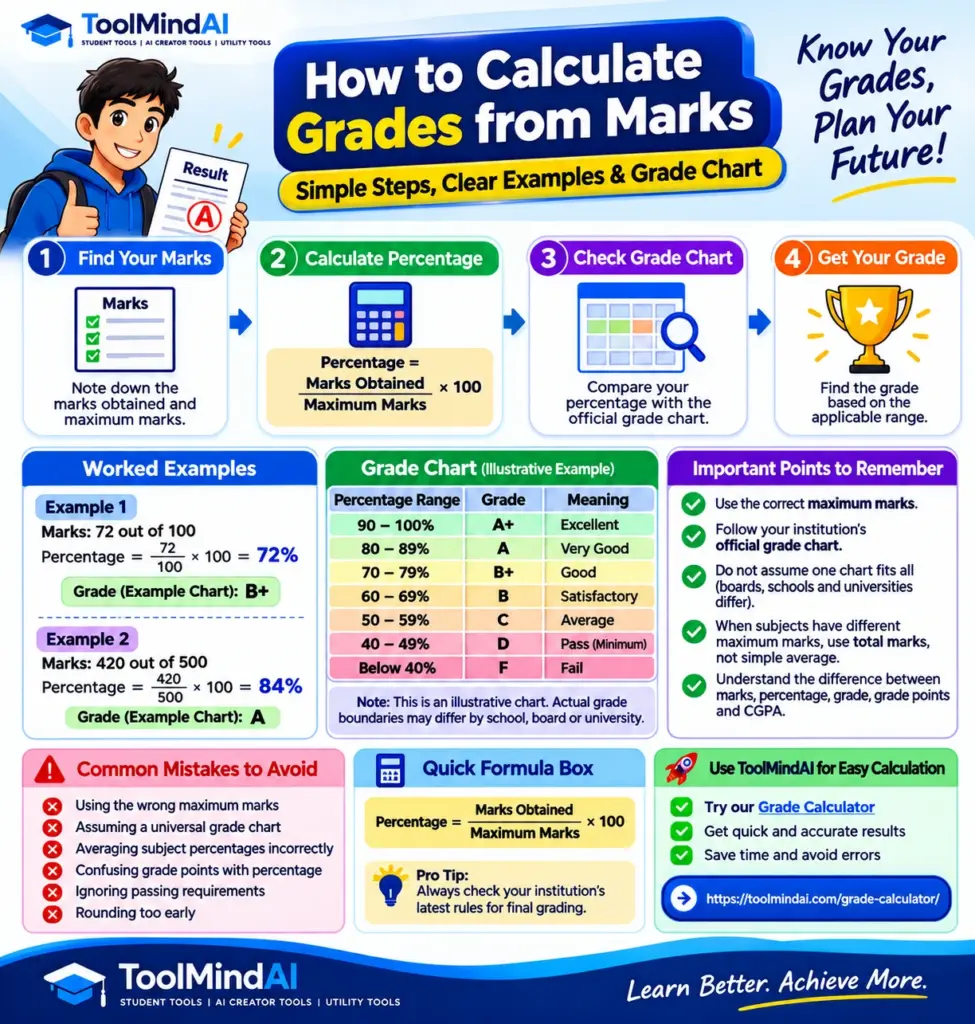
4. Grade Chart: Understanding Grades from Percentage
A grade chart maps marks or percentages to grades. Because grading policies differ, the following table is an illustrative example only, not an official grading chart for CBSE, Assam, or any particular university.
| Percentage range | Example grade | General interpretation |
|---|---|---|
| 90%–100% | A+ | Excellent |
| 80%–89% | A | Very good |
| 70%–79% | B+ | Good |
| 60%–69% | B | Satisfactory to good |
| 50%–59% | C | Basic satisfactory performance |
| 40%–49% | D | Minimum passing range in this example |
| Below 40% | F | Below the example passing threshold |
These ranges are not universal. Some institutions use different letter grades, narrower bands, grade points, separate theory and practical requirements, or different passing thresholds.
The grade chart above is an illustrative example, not the official grading scale for every examination board. CBSE publishes its own grading guidance for Classes X and XII. Students following CBSE should consult the official CBSE grading system rather than assuming that a general percentage-to-grade chart applies to their results.
Before using any grade chart, verify:
- Whether the boundaries are based on percentages or raw marks.
- Whether the lower and upper limits are inclusive.
- Whether separate passing marks apply to theory and practical examinations.
- Whether internal assessment affects the final grade.
- Whether the institution uses letter grades, grade points, or both.
Example: Finding a grade using an illustrative chart
Suppose a student scores 76 out of 100.
The percentage is:
\[ \frac{76}{100}\times100=76\% \]
Using the illustrative chart above, 76% falls in the 70%–79% range, which corresponds to B+.
Therefore, the example grade is B+ under this illustrative system. The student’s actual grade could differ under their institution’s rules.
5. How to Calculate Grades When Subjects Have Different Maximum Marks
When subjects have different maximum marks, calculate the overall percentage using the combined marks.
Formula
\[ \text{Overall Percentage}= \frac{\text{Total Marks Obtained}}{\text{Total Maximum Marks}}\times100 \]
Example
Consider the following results:
| Subject | Marks obtained | Maximum marks |
|---|---|---|
| English | 78 | 100 |
| Mathematics | 85 | 100 |
| Science | 72 | 100 |
| History | 81 | 100 |
| Computer Science | 90 | 100 |
| Total | 406 | 500 |
The overall percentage is:
\[ \frac{406}{500}\times100=81.2\% \]
The student’s overall percentage is 81.2%.
The final overall grade depends on the applicable grading policy. Some institutions calculate an overall grade from the combined percentage, while others may use grade points, credits, or specific subject-level rules.
What if the subjects have different maximum marks?
Suppose one subject is worth 100 marks and another is worth 50 marks. Do not simply average their percentages unless the institution’s rules specifically call for that method.
For an overall marks-based percentage, add the marks obtained and divide by the combined maximum marks. This correctly accounts for the different maximum marks.
6. Difference Between Marks, Percentage, Grade, Grade Points, and CGPA
These terms are connected, but they mean different things.
| Term | Meaning | Example |
|---|---|---|
| Marks | The score earned in an assessment | 84 out of 100 |
| Percentage | Marks expressed as a proportion of maximum marks | 84% |
| Grade | A category assigned under a grading scale | A |
| Grade points | Numerical values assigned to grades under a particular system | 9 points |
| CGPA | A cumulative grade-point measure across a programme or set of semesters | 8.2 CGPA |
The values in this table are illustrative, not a universal conversion system. For more worked examples, read our guide on how to calculate percentage.
Are percentage and CGPA the same?
No. Percentage expresses marks relative to maximum marks. CGPA summarizes grade-point performance according to an institution’s rules, which may include credit weighting.
There is no universal formula for converting every CGPA into a percentage. If you need to convert CGPA to percentage, follow the conversion rule prescribed by your institution.
If you need to calculate cumulative grade points, use the ToolMindAI CGPA Calculator and follow the grading and credit rules that apply to your institution.
7. Common Grade Calculation Mistakes
Mistake 1: Using the wrong maximum marks
If you score 360 out of 500, dividing by 600 instead of 500 will give you an incorrect percentage.
Always use the correct maximum marks for the assessment being calculated.
Mistake 2: Assuming every institution uses the same grade chart
A percentage that corresponds to an A grade at one institution might fall into a different category elsewhere.
Use the official grading scale for your own school, board, college, or university.
Mistake 3: Averaging subject percentages incorrectly
When subjects have different maximum marks, averaging their percentages equally may not produce the same result as calculating the overall percentage from combined marks.
Follow your institution’s method for overall results.
Mistake 4: Confusing grade points with percentages
A grade point of 8 does not automatically mean 80%. The relationship depends on the grading system.
Do not convert grade points into percentages using an assumed multiplier unless your institution prescribes that formula.
Mistake 5: Ignoring passing requirements
An overall percentage may not tell the complete story. Some institutions require separate minimum marks in theory, practicals, internal assessments, or individual subjects.
Check these requirements before interpreting your result.
Mistake 6: Rounding too early
Suppose your percentage is 79.96%. Rounding it to 80% may appear to move you into a different grade band.
Whether rounding is permitted, and at which stage it applies, depends on your institution’s rules. Keep the unrounded result until you know the official procedure.
8. How ToolMindAI Can Help You Calculate Grades
Manually calculating percentages and checking grade charts can become time-consuming when you have several subjects or different assessment totals.
The ToolMindAI Grade Calculator can help you calculate grades using the supported inputs and grading rules. Check that the selected grading scale matches your institution before relying on the result.
You can use it to check your result without repeatedly calculating the same values by hand.
For the most reliable result:
- Enter the correct marks or percentage requested by the calculator.
- Check that the maximum marks or grading scale is appropriate.
- Review the calculated result.
- Compare it with your institution’s official grading rules when those rules affect the final grade.
An online calculator is useful for mathematical assistance, but it should not replace your official result sheet, institution-specific grade chart, or academic regulations.
If you are calculating your overall percentage first, you can also use the ToolMindAI Percentage Calculator.
9. Important Limitations of Grade Calculations
Grade calculations can be straightforward when the grading scale is clearly defined. However, real academic results may involve additional rules.
For example:
- A board may use a prescribed grading system.
- A university may assign grade points based on marks bands.
- A course may require separate passing marks for theory and practicals.
- Some programmes may use credit-weighted calculations.
- Some institutions may apply moderation or other assessment rules.
- A final grade may depend on internal assessments as well as examination marks.
This guide explains general calculation methods; it does not establish an official grade chart for every institution.
For academic decisions, always consult your current official grading regulations or examination office. This is particularly important when checking pass/fail status, scholarship eligibility, admission requirements, or final results.
Frequently Asked Questions
1. How do you calculate grades from marks?
First calculate the percentage by dividing marks obtained by maximum marks and multiplying by 100. Then compare the percentage with your institution’s official grade chart.
For example, 420 out of 500 equals 84%. The corresponding grade depends on the applicable grading scale.
2. What is the formula for calculating percentage from marks?
The formula is:
Percentage = (Marks Obtained ÷ Maximum Marks) × 100
For example, 75 out of 100 equals 75%.
3. How do I calculate my grade if I know my percentage?
Find the percentage range containing your result in the official grading scale used by your institution. The grade assigned to that range is your grade, subject to any additional academic rules.
4. Is there a universal grade chart for students in India?
No single grade chart applies to every school, examination board, college, and university in India. The relevant grade boundaries depend on the institution and programme.
Always verify the applicable official grading scale.
5. How do I calculate an overall grade from multiple subjects?
First determine the method prescribed by your institution. For a simple combined-marks percentage, add the marks obtained across the subjects, add their maximum marks, and divide the first total by the second. Multiply by 100.
The final grade may then be determined from the applicable overall grading rules.
6. What is the difference between a grade and grade points?
A grade is a category, such as A or B. Grade points are numerical values assigned to grades under a particular grading system.
The relationship between a grade and its grade-point value depends on the institution’s rules.
7. Can I calculate my grade without knowing the grading scale?
You can calculate your percentage from marks without a grade chart. However, you generally cannot determine the official letter grade accurately without knowing the applicable grading scale.
8. Does 80% always mean an A grade?
No. An 80% score may correspond to different grades under different grading systems. Check your institution’s official grade boundaries.
9. Can an online grade calculator determine my official result?
An online calculator can perform calculations based on the inputs and rules it supports. It cannot independently verify your official marks, institutional assessment decisions, or every academic regulation.
Use your official result and grading policy as the final reference.
10. Are grade points and CGPA the same?
No. Grade points are values assigned to individual grades, while CGPA is a cumulative grade-point measure calculated according to a programme’s rules. Credit weighting and other institutional requirements may affect the calculation.
Final Thoughts
Learning how to calculate grades from marks helps you understand your academic performance more clearly. Start by calculating your percentage accurately, then use the official grade chart that applies to your institution.
When calculating results across several subjects, use the correct maximum marks and follow the prescribed method. Avoid assuming that one grading scale or CGPA conversion formula applies everywhere.
Explore the Student Tools collection for more academic calculators and educational resources.
Continue Learning
Explore these related ToolMindAI resources:
- Percentage Calculator — calculate percentages from marks and other values.
- How to Calculate Percentage — understand percentage formulas and worked examples.
- CGPA Calculator — calculate CGPA using the appropriate academic information.
- How to Calculate CGPA — learn about grade points, credits, SGPA, and CGPA.
- Student Tools — explore more academic calculators and educational resources.