
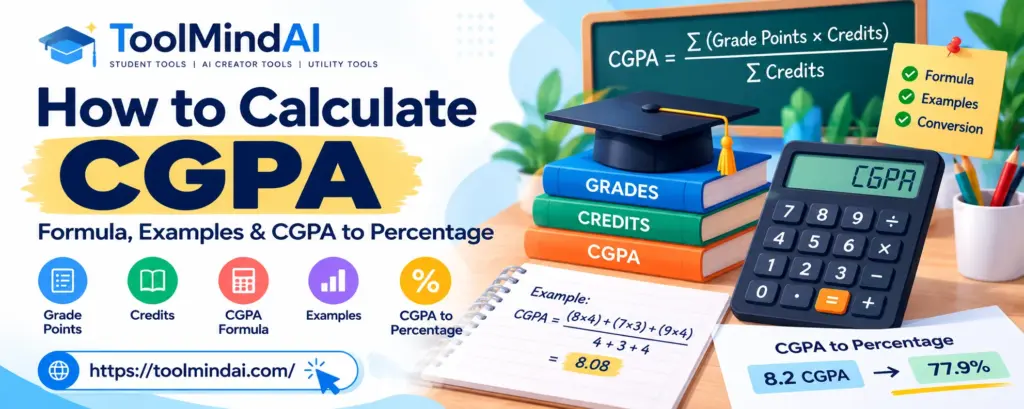
CGPA is one of the most common academic performance measures used by schools, colleges, and universities. Students often see a CGPA on their marksheet or grade card and then need to understand what it means, how it was calculated, or how it can be converted into a percentage.
The calculation itself can be straightforward, but there is an important detail: CGPA systems are not identical everywhere. Some institutions calculate CGPA using credit-weighted grade points, while others use specific institutional grading rules. Similarly, a CGPA-to-percentage conversion formula may be defined by the particular board or university.
For example, CBSE has published an indicative conversion of overall percentage as 9.5 × CGPA, whereas Assam University has an official notice stating that its percentage equivalent is CGPA × 10.
This guide explains how CGPA works, how to calculate it, how credits affect the calculation, how CGPA differs from SGPA and percentage, and why you should always check your institution’s official conversion rule. So, it this article we will discuss about how to calculate CGPA, formula and examples.
Quick Answer: How Is CGPA Calculated?
For a simple system where every subject carries equal weight, CGPA can be calculated by adding the grade points and dividing by the number of subjects:
CGPA = Sum of Grade Points ÷ Number of Subjects
For credit-based systems, a weighted calculation is generally used:
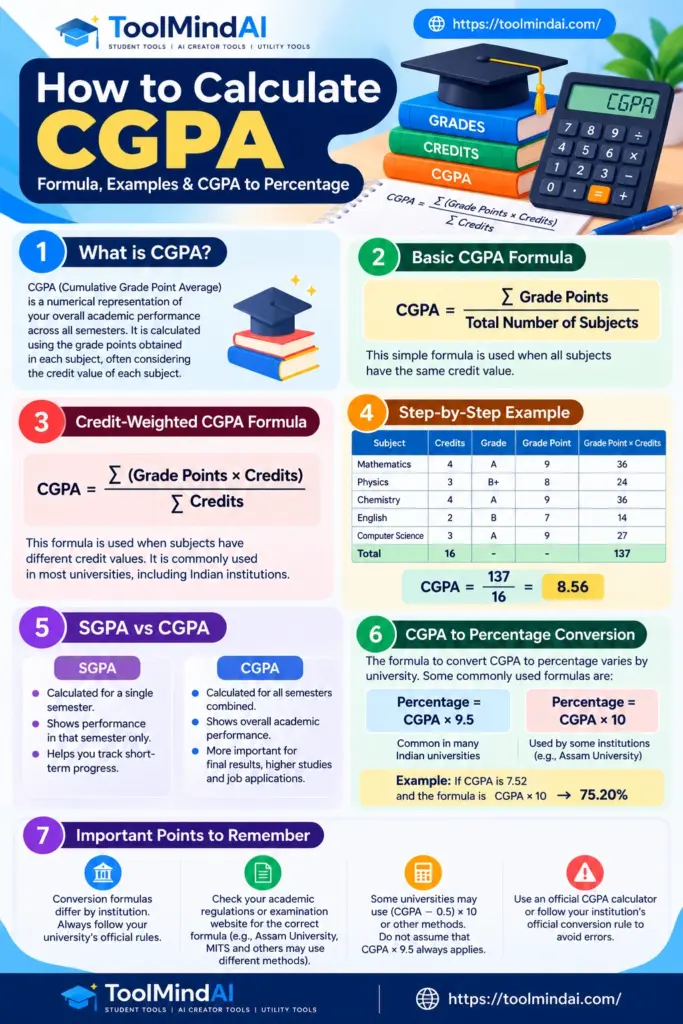
CGPA = Σ(Grade Point × Credit) ÷ ΣCredits
The exact method depends on the academic system used by your institution.
Key Takeaways
- CGPA means Cumulative Grade Point Average.
- A simple CGPA can be calculated by averaging grade points.
- Credit-based systems may use weighted grade points.
- SGPA usually represents performance for a semester, while CGPA represents cumulative performance.
- CGPA and percentage are different ways of representing academic performance.
- There is no universal CGPA-to-percentage formula.
- Always follow the conversion rule stated by your school, board, university, or marksheet.
What Is CGPA?
CGPA stands for Cumulative Grade Point Average.
It represents academic performance using grade points rather than directly reporting marks as a percentage.
For example, an academic system might assign grade points such as:
| Grade | Example Grade Point |
|---|---|
| A+ | 9 |
| A | 8 |
| B+ | 7 |
| B | 6 |
| C | 5 |
The exact grade-point scale varies by institution, so these numbers are only an illustration. If you also need to determine a grade from marks or percentage, you can use the Grade Calculator.
CGPA is called cumulative because it represents performance across the relevant subjects, semesters, or programme period rather than only one examination.
How to Calculate CGPA
The simplest situation is when every subject has equal importance or equal credit weight.
Use:
CGPA = Sum of Grade Points ÷ Number of Subjects
Example
Suppose a student receives these grade points:
| Subject | Grade Point |
|---|---|
| Mathematics | 8 |
| English | 7 |
| Science | 9 |
| History | 8 |
| Computer Science | 9 |
First add the grade points:
8 + 7 + 9 + 8 + 9 = 41
There are five subjects.
Now divide:
41 ÷ 5 = 8.2
Therefore:
CGPA = 8.2
This is a basic arithmetic average. It should only be used when the grading system permits this approach.
How to Calculate CGPA Using Credits
Many higher-education systems give different courses different credit values.
For example, a four-credit course may contribute more to the cumulative result than a two-credit course. In such cases, simply averaging the grade points can give the wrong result.
A credit-weighted calculation can be represented as:
CGPA = Σ(Grade Point × Credit) ÷ ΣCredits
Example
Suppose a student has:
| Subject | Grade Point | Credits |
|---|---|---|
| Mathematics | 8 | 4 |
| English | 7 | 3 |
| Computer Science | 9 | 4 |
| Environmental Studies | 8 | 2 |
Calculate each grade point × credit:
- Mathematics: 8 × 4 = 32
- English: 7 × 3 = 21
- Computer Science: 9 × 4 = 36
- Environmental Studies: 8 × 2 = 16
Total weighted points:
32 + 21 + 36 + 16 = 105
Total credits:
4 + 3 + 4 + 2 = 13
Therefore:
105 ÷ 13 = 8.08
The credit-weighted CGPA is approximately 8.08.
The important lesson is that credit values matter when the institution uses a credit-based system.
How Is CGPA Calculated Across Semesters?
For a multi-semester programme, CGPA may be calculated using the semester grade-point averages and their corresponding credits.
A general weighted approach is:
CGPA = Σ(SGPA × Semester Credits) ÷ ΣSemester Credits
This means a semester carrying more credits can have a larger effect on the cumulative result.
For example, Assam University’s published CBCS material describes cumulative performance as a weighted average of semester SGPAs using the total credits of each semester.
This is why students should not automatically average all semester SGPAs unless their institution specifically says that is the correct method.
CGPA vs SGPA: What’s the Difference?
The two terms are related but represent different academic periods.
| SGPA | CGPA |
|---|---|
| Semester Grade Point Average. | Cumulative Grade Point Average. |
| Usually represents one semester. | Represents cumulative performance. |
| Calculated using that semester’s courses/credits. | Combines the applicable cumulative performance. |
| Can change significantly from semester to semester. | Changes as additional semesters are included. |
For example, a student could have:
- Semester 1 SGPA: 7.8
- Semester 2 SGPA: 8.2
- Semester 3 SGPA: 8.5
The student’s CGPA would depend on the institution’s cumulative calculation method and the applicable semester credits.
CGPA vs Percentage
CGPA and percentage are not the same measurement.
A percentage generally expresses marks relative to a maximum of 100.
CGPA represents academic performance using grade points according to a particular grading system.
If you want to understand how marks are converted into a percentage, see our guide on how to calculate percentage.
For example:
Percentage: 78%
CGPA: 8.1
You cannot automatically assume that 8.1 CGPA always equals the same percentage everywhere.
The conversion depends on the applicable academic rules.
How to Convert CGPA to Percentage
This is where students need to be particularly careful.
There is no single universal CGPA-to-percentage formula for every school, board, college, or university.
Different institutions may prescribe different conversion methods.
Example: CBSE
CBSE has published an indicative equivalence in which:
Overall indicative percentage = 9.5 × CGPA
So, under that particular rule:
CGPA = 8.2
8.2 × 9.5 = 77.9%
However, this formula should not automatically be applied to every university CGPA. CBSE’s published rule applies to the relevant CBSE grading context.
In the CBSE context, an overall percentage has been indicated using a 9.5 multiplier. You can also review the CBSE’s published CGPA-to-percentage guidance for the original context.
Example: Assam University
Assam University has published an official conversion notice stating:
Percentage equivalent of CGPA = CGPA × 10
Therefore, under that university’s stated conversion:
CGPA = 7.52
7.52 × 10 = 75.20%
This is an excellent example of why students should check their institution’s rules instead of assuming that 9.5 is always the correct multiplier.
Other universities use still different formulas. For example, MITS’s 2025 academic regulations specify CGPA-to-percentage = (CGPA − 0.5) × 10 for the stated programme rules.
For Assam University, the applicable conversion rule states that the percentage of marks is calculated as CGPA × 10. For example, a CGPA of 7.52 corresponds to 75.20%. You can refer to Assam University’s official CBCS regulations for the university’s grading and conversion rules.
The safest rule
Before converting CGPA to percentage:
- Check your marksheet.
- Check your university’s examination regulations.
- Check the official academic handbook.
- Look for an official conversion certificate or notification.
- Use the prescribed formula for your institution.
If your university provides a conversion formula, that formula takes priority over a general online formula.
Why You Should Not Assume CGPA × 9.5 Always Works
The 9.5 multiplier is widely encountered in Indian academic contexts, but it is not a universal mathematical law for CGPA conversion.
Official and institutional examples demonstrate different rules:
- CBSE: 9.5 × CGPA in its published indicative conversion.
- Assam University: CGPA × 10.
- Some university regulations use other formulas.
Therefore, an online calculator can calculate a conversion only when the appropriate conversion rule is known.
This distinction is especially important when submitting academic information for admissions, scholarships, employment, or other official purposes.
Other institutions may prescribe different formulas for converting CGPA to percentage. For example, MITS’s University Examination Office provides CGPA-to-percentage conversion services and publishes its academic regulations. Its B.Tech regulations specify a notional conversion formula of (CGPA − 0.5) × 10.
Common CGPA Calculation Mistakes
1. Treating CGPA as percentage
A CGPA of 8 does not automatically mean 80%. The conversion depends on the applicable grading system.
2. Ignoring credits
If courses have different credit values, simply averaging grade points may produce an incorrect result.
3. Confusing SGPA and CGPA
SGPA generally relates to a semester, while CGPA represents cumulative performance.
4. Using 9.5 automatically
The 9.5 multiplier should not be treated as a universal conversion formula.
5. Rounding too early
Keep sufficient precision during calculations and round the final result according to your institution’s requirements.
6. Using an unofficial conversion for applications
If an admission authority or employer asks for percentage, use the conversion prescribed by your institution or the authority requesting the information.
How ToolMindAI Can Help
ToolMindAI provides educational calculators designed to help students perform common academic calculations. ToolMindAI also provides an Attendance Calculator for students who need to calculate their attendance percentage separately.You can use the CGPA Calculator to check your calculation after applying the appropriate grading and credit rules.
A good workflow is:
Understand the formula → Enter the correct data → Calculate → Verify against your institution’s rules
For CGPA calculations, the most important input is not just the grade point. You may also need:
- Course credits.
- Semester credits.
- SGPA values.
- The applicable grading system.
- Your institution’s conversion rule.
A calculator can help with the arithmetic, but it cannot determine which institutional policy applies to your academic record.
Important Limitations
CGPA calculations are institution-dependent.
A school, college, university, board, or professional programme may use its own:
- Grade-point scale.
- Credit system.
- SGPA calculation method.
- CGPA calculation method.
- Rounding rules.
- CGPA-to-percentage conversion.
For example, Assam University’s official materials currently show a CGPA × 10 conversion, while CBSE’s published material uses an indicative 9.5 multiplier in its applicable context.
Therefore, never use a generic online conversion for an official application when your institution provides a specific rule.
Frequently Asked Questions
What does CGPA stand for?
CGPA stands for Cumulative Grade Point Average. It represents cumulative academic performance using grade points. The exact scale and calculation method depend on the institution’s academic regulations.
What is the basic CGPA formula?
For equally weighted subjects, CGPA can be calculated as the sum of the grade points divided by the number of subjects. Credit-based systems may instead use a weighted formula involving grade points and credits.
How do I calculate CGPA with credits?
Multiply each course’s grade point by its credit value, add the resulting credit points, and divide by the total number of credits. The exact calculation should follow your institution’s academic regulations.
Is CGPA the same as percentage?
No. CGPA and percentage are different academic measurements. A percentage expresses marks relative to 100, while CGPA represents performance using grade points.
How do I convert CGPA to percentage?
You need to use the conversion formula specified by your institution or board. There is no universal formula that applies to every CGPA system.
Is CGPA × 9.5 always correct?
No. CBSE has published an indicative 9.5 × CGPA conversion, but other institutions may use different formulas. Assam University, for example, officially states CGPA × 10 for its conversion.
What is the difference between SGPA and CGPA?
SGPA generally represents performance for a particular semester, while CGPA represents cumulative performance across the applicable academic period.
Can I calculate CGPA by simply averaging semester SGPAs?
Not always. If semesters have different credit weights, a weighted calculation may be required. Follow your institution’s prescribed formula.
Why does my university’s CGPA conversion differ from another university?
Different institutions can use different grading scales and conversion policies. CGPA-to-percentage conversion is an institutional or programme-specific rule rather than a universal mathematical conversion.
Should I use an online CGPA calculator for an official application?
You can use an online calculator to check arithmetic, but for an official application, use the conversion method specified by your university, board, or the organization requesting the information.
Final Thoughts
CGPA is a useful way to represent cumulative academic performance, but calculating it correctly requires more than simply adding numbers.
For equally weighted subjects, a basic average of grade points may be sufficient. In credit-based systems, grade points and credits generally need to be considered together. For multiple semesters, the applicable semester credits may also affect the cumulative calculation.
The most important point is CGPA-to-percentage conversion. Do not assume that every institution uses the same formula. CBSE has published an indicative 9.5 × CGPA conversion, while Assam University officially states CGPA × 10, and other universities may use different methods.
When your academic result is being used for admission, employment, scholarships, or another official purpose, always follow the conversion rule provided by the institution responsible for your marksheet.
Continue Learning
After understanding CGPA, students may also find it useful to learn how to calculate percentage from marks, understand academic grades, and calculate attendance percentage.
Explore the Student Tools collection on ToolMindAI for additional academic calculators and educational resources.