

Planning your study time can make school, college, and exam preparation easier to manage. Instead of studying whenever you find free time, you can calculate how many hours are available, divide them between subjects, and create a realistic study timetable.
Learning how to calculate study time does not mean studying for as many hours as possible. It means using your available time effectively while leaving room for sleep, meals, classes, exercise, breaks, and other responsibilities.
In this guide, you will learn how to calculate daily and weekly study hours, divide time between subjects, estimate the time needed for revision, and prepare a practical study schedule. You will also see worked examples that show how to turn a busy day into a manageable study plan.
Whether you are a school student, a college student, or preparing for an examination, the basic method is simple: identify your available time, decide what you need to study, and assign realistic time blocks to each task.
Study Time Calculator
Use the ToolMindAI Study Time Calculator to help plan your study sessions. Enter your available study time and other requested details in the calculator to estimate a study schedule. Treat the result as a planning guide, then adjust it to match your subjects, deadlines, and personal routine.
Use the Study Time Calculator to organise your available study hours and plan a realistic study schedule. Treat the result as a planning guide, then adjust it to match your subjects, deadlines, and personal routine.
Before making a schedule, it helps to understand what study time includes and how to calculate it accurately.
What Is Study Time?
Study time is the amount of time you spend learning, practising, revising, or completing academic tasks outside—or, where appropriate, alongside—your regular classes.
It can include activities such as:
- Reading textbooks and class notes.
- Solving mathematics or science problems.
- Revising previously learned topics.
- Preparing assignments and projects.
- Practising questions for examinations.
- Reviewing mistakes and identifying topics that need more work.
Not every minute at a desk is necessarily productive study time. For example, a 60-minute session that includes 15 minutes of unrelated phone use contains only 45 minutes of focused study.
For planning purposes, it is useful to distinguish between scheduled study time and focused study time. Scheduled time is the period reserved for studying. Focused time is the portion spent actually working on the academic task.
This distinction helps you make more realistic plans. If you schedule two hours for studying, include breaks where needed and avoid assuming that every minute will be uninterrupted concentration.
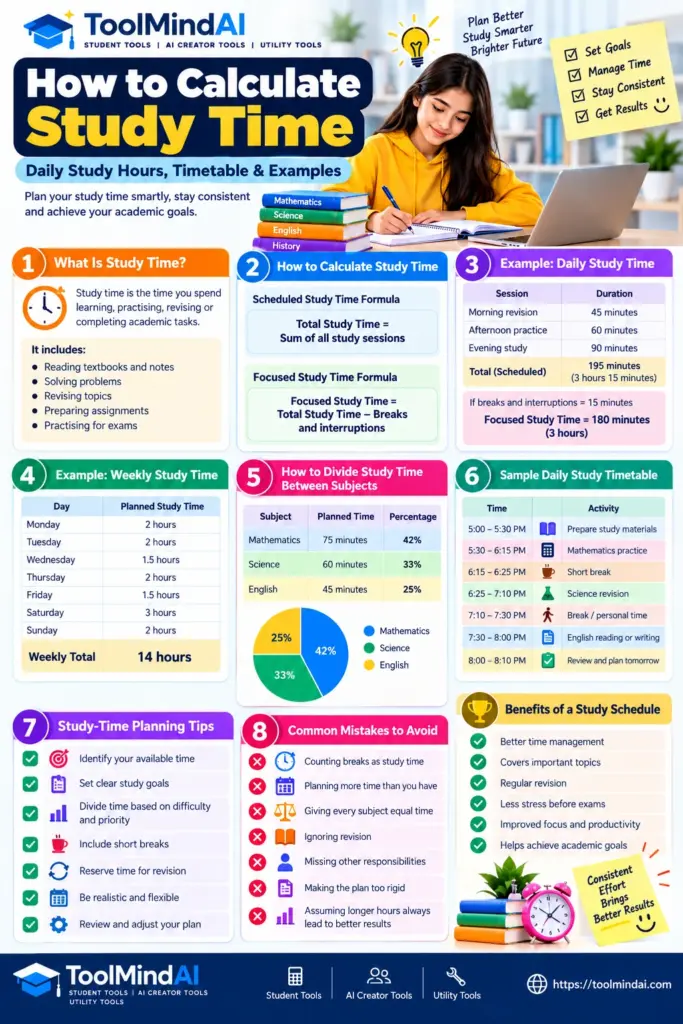
How to Calculate Study Time
The basic method is to add the time spent on your study sessions. If you want to calculate your focused study time, subtract breaks and other interruptions from the total scheduled period.
Formula for scheduled study time:
Scheduled study time = Sum of all planned study sessions
Formula for focused study time:
Focused study time = Total study-session duration − Breaks and interruptions
For example, suppose you study for 45 minutes in the morning, 60 minutes in the afternoon, and 90 minutes in the evening.
Your total scheduled study time is:
45 + 60 + 90 = 195 minutes
Convert minutes into hours by dividing by 60:
195 ÷ 60 = 3.25 hours
That means you have scheduled 3 hours and 15 minutes of study time.
Now suppose those sessions include a total of 15 minutes of breaks or interruptions. Your focused study time would be:
195 − 15 = 180 minutes
That equals 3 hours of focused study.
This calculation is useful for reviewing your routine at the end of the day. It also helps you avoid overestimating how much time you actually spent studying.
How to Calculate Daily Study Hours
To calculate daily study hours, first identify the time you can realistically reserve for studying after accounting for your classes, responsibilities, meals, rest, and other commitments.
Follow these steps:
- List your fixed daily commitments, such as school, college, work, or tuition.
- Identify the free periods in which you can reasonably study.
- Choose study sessions that fit those periods.
- Add the duration of each session.
- Subtract breaks if you want to estimate focused study time.
Example: Calculating daily study hours
Imagine a student plans three study sessions:
| Session | Duration |
|---|---|
| Morning revision | 30 minutes |
| Afternoon practice | 60 minutes |
| Evening study | 90 minutes |
| Total | 180 minutes |
Convert the total into hours:
180 ÷ 60 = 3 hours
The student has scheduled three hours of study time for the day. If the sessions include 20 minutes of breaks and interruptions, focused study time is 160 minutes, or 2 hours and 40 minutes.
This does not mean three hours is the ideal amount for every student. A learner’s needs depend on their current workload, learning goals, examination schedule, and how much independent practice is required.
The purpose of the calculation is to understand how your time is being used and create a plan you can follow consistently.
How to Calculate Weekly Study Time
Weekly study time helps you see whether your daily routine is sufficient for your current goals. It is particularly useful when you have several subjects, assignments, or an upcoming examination.
Use this formula:
Weekly study time = Sum of study hours across the week
For a quick estimate, multiply your planned daily study time by the number of days you intend to study. If your schedule changes from day to day, add each day’s planned hours separately instead.
Example: Weekly study-time calculation
Suppose a student plans the following schedule:
| Day | Planned study time |
|---|---|
| Monday | 2 hours |
| Tuesday | 2 hours |
| Wednesday | 1.5 hours |
| Thursday | 2 hours |
| Friday | 1.5 hours |
| Saturday | 3 hours |
| Sunday | 2 hours |
| Weekly total | 14 hours |
The total is 14 hours for the week.
This is a calculation example, not a recommended target for every student. Someone with a lighter workload may need less time, while a student preparing for a demanding examination may need a different schedule. Review your progress and adjust the plan rather than following a number simply because it appears in an example.
How to Divide Study Time Between Subjects
When you study several subjects, dividing your available time thoughtfully can help you avoid spending too much time on one topic while neglecting another.
A useful starting point is to consider three factors:
- Difficulty: How challenging is the subject or topic for you?
- Priority: Is there an upcoming test, assignment, or deadline?
- Workload: How much reading, practice, revision, or problem-solving remains?
You can use these factors to assign study blocks. For example, a subject that requires extensive problem-solving may need more practice time than a topic that only requires a short review.
Avoid automatically dividing your study time equally among all subjects. Equal time can be appropriate in some situations, but it is not always the most useful choice.
Example: Dividing three hours among subjects
Suppose a student has three hours available and wants to study mathematics, science, and English.
| Subject | Planned time |
|---|---|
| Mathematics | 75 minutes |
| Science | 60 minutes |
| English | 45 minutes |
| Total | 180 minutes |
The schedule totals three hours. Mathematics receives more time because the student has decided to prioritise problem-solving that day.
The allocation should change when priorities change. If an English examination is approaching, the student might assign more time to English and reduce another session temporarily.
You can also rotate subjects across the week rather than trying to cover every subject every day. The best arrangement is one that matches your workload and gives important topics sufficient attention.
How to Create a Realistic Study Timetable
A study timetable turns your calculated study hours into a plan you can follow. It should fit around your existing responsibilities rather than requiring you to reorganise your entire life around studying.
Start by identifying your most important academic tasks. These might include preparing for an examination, completing an assignment, practising difficult questions, or revising a chapter. Then allocate time according to priority and available energy.
A practical timetable should include:
- Fixed commitments: Classes, tuition, work, and other responsibilities.
- Study sessions: Specific subjects or tasks for each available block.
- Short breaks: Time to rest between demanding sessions.
- Revision periods: Opportunities to revisit topics instead of only studying new material.
- Flexible time: A buffer for unexpected work or tasks that take longer than expected.
For additional guidance on organising study time, assignments, and other commitments, see the University of Utah Learning Center’s time-management resources.
Sample daily study timetable
The following timetable is an illustration for a student who has some free time after school or college. Adjust it to suit your own routine.
| Time | Activity |
|---|---|
| 5:00–5:30 PM | Rest and prepare study materials |
| 5:30–6:15 PM | Mathematics practice |
| 6:15–6:25 PM | Short break |
| 6:25–7:10 PM | Science revision |
| 7:10–7:30 PM | Break or personal time |
| 7:30–8:00 PM | English reading or writing |
| 8:00–8:10 PM | Review completed tasks and plan tomorrow |
In this example, the timetable includes 45 minutes of mathematics, 45 minutes of science, and 30 minutes of English. That gives the student 2 hours of scheduled study time, excluding the breaks and other activities.
The schedule is a starting point, not a rule. If you are tired after a long school day, you may need a shorter session. If an examination is approaching, you might temporarily allocate more time to revision.
A useful timetable is one you can maintain and adjust, not one that looks impressive on paper but becomes difficult to follow.
How to Calculate Study Time for an Examination
When preparing for an examination, work backwards from the exam date. List the chapters or topics you need to cover, estimate how much time each requires, and reserve time for revision and practice questions.
Use this basic calculation:
Available preparation time = Number of available study days × Planned study time per day
For example, suppose a student has 12 days before an examination and can realistically study for two hours per day.
12 × 2 = 24 hours
The student has planned 24 hours of study time before the examination.
That does not automatically mean 24 hours will be sufficient. The student must compare the available time with the amount of material remaining and adjust the plan if necessary.
A practical approach is to divide the available time into three types of work:
- Learning: Covering topics that have not been understood or completed.
- Practice: Solving questions and applying what you have learned.
- Revision: Reviewing notes, correcting mistakes, and revisiting difficult concepts.
When planning revision, include active practice rather than relying only on rereading notes. Cornell University’s Learning Strategies Center explains approaches such as retrieval practice and spaced practice in its guide to effective study strategies.
For instance, the student might initially allocate more time to unfinished chapters, then shift towards practice and revision as the examination approaches. The exact allocation depends on the subject, syllabus, and current level of preparation.
Do not leave all revision until the final day. Reserve some time to revisit earlier topics, and avoid filling every available minute with new material.
Study Breaks and Focused Study Time
Breaks are part of a realistic schedule. Studying continuously for a long period may become tiring, and your ability to concentrate can vary throughout the day.
One option is to study for a set period and then take a short break. Some students use 25-minute sessions followed by five-minute breaks; others prefer longer sessions, particularly for mathematics, writing, or complex problem-solving.
There is no single session length that works best for everyone. Experiment with a manageable routine and observe whether you can concentrate, understand the material, and complete tasks effectively.
Break schedules are flexible rather than universal. The University of Rochester’s Learning Center shares practical suggestions for planning short and longer study breaks in its guide to taking study breaks.
When reviewing your study time, distinguish between the total time reserved for a session and the time spent actively working.
For example, a 50-minute session with a 10-minute break contains 40 minutes of focused work if the remaining time is spent studying. If interruptions occur, record them honestly instead of treating the entire session as productive study.
During breaks, try to step away from the task briefly, stretch, drink water, or rest your eyes. If checking your phone regularly turns a five-minute break into a much longer interruption, keep it away during focused sessions.
The goal is not to eliminate every break. It is to create a sustainable routine that supports learning.
Common Study-Time Calculation Mistakes
Even a simple study plan can become unrealistic if you make assumptions about how much time is available or how quickly tasks can be completed.
1. Counting breaks as focused study
A two-hour block that includes breaks does not necessarily contain two hours of focused work. Record scheduled time and focused time separately when accuracy matters.
2. Planning more time than you actually have
A timetable may look productive but fail if it ignores classes, household responsibilities, travel, meals, or rest. Start with your real availability.
3. Giving every subject equal time automatically
Equal division is not always appropriate. Some subjects require more practice, and some topics may be more urgent because of upcoming deadlines.
4. Forgetting revision
Finishing a chapter is not the same as remembering it later. Reserve time to review previous material and practise questions.
5. Ignoring task difficulty
Reading a short chapter and solving a challenging problem set may require very different amounts of time. Estimate each task separately where possible.
6. Making the timetable too rigid
Unexpected tasks can disrupt a schedule. Leave some flexible time and revise the plan when circumstances change.
7. Treating more hours as automatic improvement
A longer study session does not guarantee better learning. Concentration, practice quality, understanding, revision, and adequate rest also matter.
How ToolMindAI Can Help You Plan Study Time
ToolMindAI provides student-focused tools intended to simplify common academic calculations and planning tasks. The Study Time Calculator can help you organise your available study time, while other calculators support related academic needs.
You can also use the Attendance Calculator to calculate your attendance percentage and understand how much of your scheduled class time you have attended.
For academic calculations, you can use the Percentage Calculator to calculate percentages from marks. If you are reviewing your cumulative academic performance, the CGPA Calculator can help you work with grade-point averages.
These tools address different questions, but they can be useful alongside a study plan. Calculators do not decide what you should learn or guarantee academic results. You still need to select appropriate study tasks, follow your institution’s requirements, and review your progress.
Explore the ToolMindAI homepage to find additional student resources.
Frequently Asked Questions
1. How do I calculate my daily study time?
Add the durations of your study sessions. If you want to calculate focused study time, subtract breaks and interruptions from the total scheduled duration.
2. How do I calculate weekly study hours?
Add your planned study hours for each day of the week. If you follow the same schedule every day, multiply the daily hours by the number of study days.
3. How many hours should a student study daily?
There is no single number that suits every student. The appropriate amount depends on academic workload, learning goals, upcoming examinations, individual needs, and available time.
4. How can I divide study time between subjects?
Consider subject difficulty, upcoming deadlines, unfinished topics, and the amount of practice required. Allocate time according to priorities and adjust your schedule as those priorities change.
5. Should breaks be included in study time?
You can include breaks in your total scheduled block, but separate them from focused study time when measuring how long you actively studied.
6. How do I calculate study time before an examination?
Count the available preparation days and multiply them by your realistic daily study time. Compare the total with your remaining syllabus and reserve time for practice and revision.
7. Is a study timetable necessary?
A timetable is not compulsory, but it can help you organise tasks, notice neglected subjects, and use available time more deliberately. A simple, flexible plan may be enough.
8. What should I do if I cannot follow my timetable?
Review why the plan failed. You may have underestimated task durations, scheduled too much work, or overlooked other responsibilities. Adjust the schedule instead of repeatedly trying to follow an unrealistic plan.
9. Is studying longer always better?
Not necessarily. The value of study time also depends on concentration, understanding, active practice, revision, and rest. A realistic routine is generally more useful than an unnecessarily demanding schedule.
10. Can a study-time calculator improve my results?
A calculator can help organise time and make a plan easier to understand. Academic improvement still depends on how you use that time, the quality of your study methods, and your individual learning needs.
Continue Learning with ToolMindAI
Explore ToolMindAI’s student resources to find more educational calculators and practical learning tools.
Final Thoughts
Calculating study time is a practical way to understand how you use your day and build a more manageable study routine. By adding study sessions, separating breaks from focused work, and dividing time according to subject priorities, you can make a plan that better reflects your actual needs.
Start with your available hours, choose a few clear tasks, and review your progress regularly. Adjust your timetable when your workload changes, and leave room for revision and rest.
The aim is not to fill every free minute with studying. It is to use your available time purposefully and develop a routine that you can maintain.